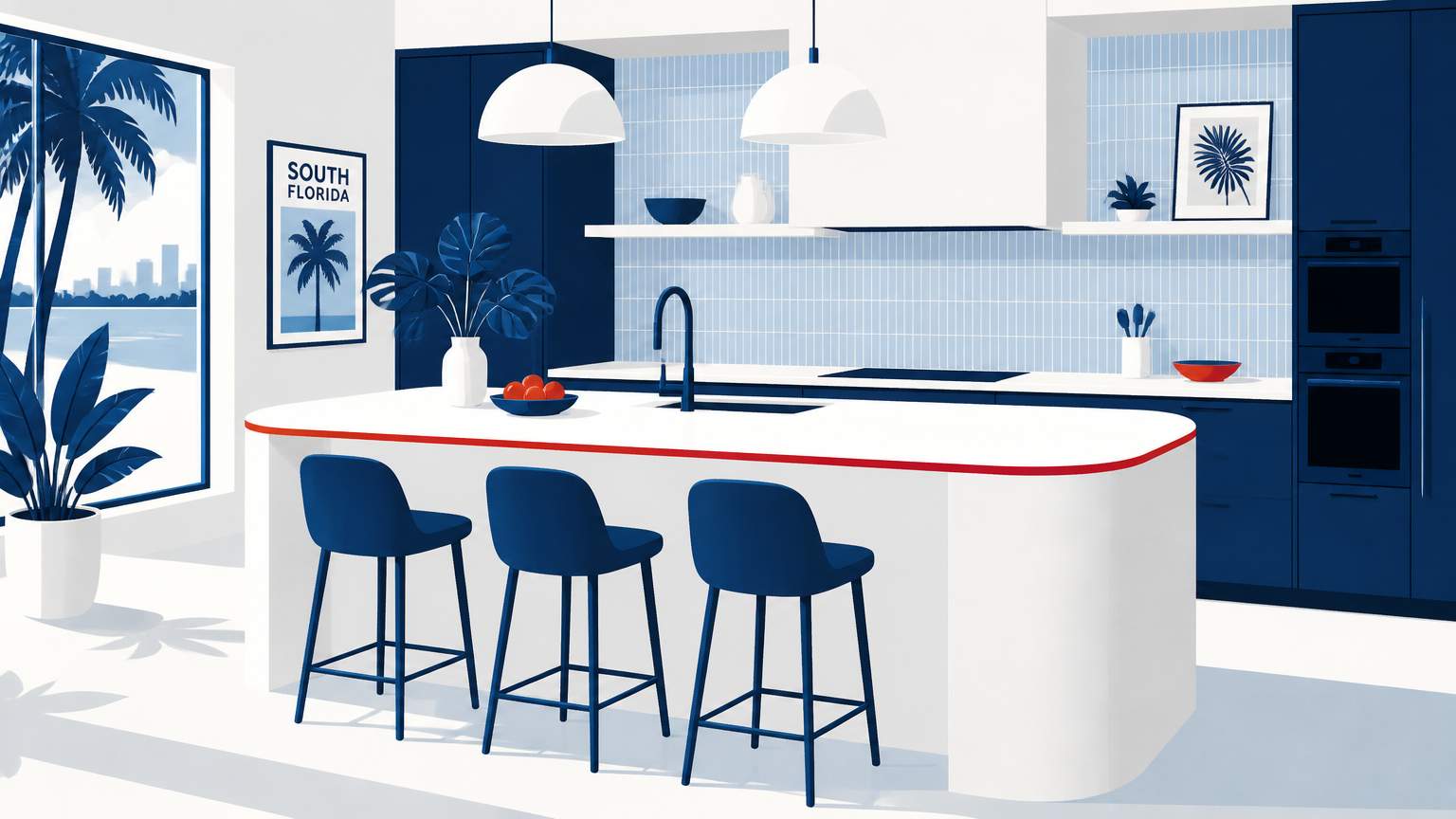
In South Florida, porcelain slabs and quartz are the countertop materials that can withstand moisture, humidity, and salt exposure. They also hold up better against UV radiation than granite. However, installing very thin, curved edges tends to cost more and deliver less durability than traditional styles do.
This framework helps you decide what countertop to choose based on the material's performance, your design goals, and your budget.
Porcelain slabs are created from a special type of vitrified ceramic, which keeps moisture from soaking into them. Unlike granite, they don't demand yearly sealing. They also resist UV rays and salt. As for quartz, the surface is a blend of around 90% ground quartz and 10% resin; it has the same advantages as porcelain.
Granite does not perform as well, because it varies in density and, in a coastal environment, the salt and water can make the need for sealant greater. Whereas porcelain and quartz perform well in humid, coastal environments, granite can struggle if not sealed properly, meaning it could stain.
Curved edges require machining (using water-jet or CNC cutting), as well as extra time to template the item. This adds to labor costs and increases waste. Purely from a materials angle, the stone itself is not significantly more expensive, but the complexity in working with very tight curves (less than 300mm) ups the cost.
Edge profiles can also affect durability. Bullnose and eased edges tend to be the most robust, while full bullnose or ogee edges may be more prone to chipping. Curved edges can last just as long as straighter ones, but the added work can see the final price tag soar. For a South Florida home renovation, this leads to the question of whether the mixed design benefit and labor cost associated with a softer line is worth it.
Climate Tolerance: It’s critical to know if the countertop can stand up to humidity and salt. As noted, porcelain and quartz offer good resistance, while granite will need more attention.
Design Style: Select the right material for your design aesthetic. For instance, porcelain can mimic the look of various stone finishes like marble or quartz, while quartz has a diverse palette of colors and subtle marble-like veining.
Budget Tiers: Pricing also matters: porcelain slabs range from $70 to $150 per square foot; quartz runs $80 to $200; granite varies from $60 to $180. Installation is another $30 to $60 per square foot, and it’s usually a good idea to budget for an extra 10-20%.
Licensed Contractor: Ensure the contractor holds a Florida residential contractor license. This is especially important in South Florida. They should also carry general liability and workers' compensation insurance.
Edge Profile: You may find yourself wanting to choose between an ultra-thin curved edge and a more traditional bullnose.
Most municipalities need a building permit if the countertop change involves new plumbing or electrical work or alters structural support.
In Boca Raton, additional checks include reviewing the calculations of the countertop's load-bearing capabilities and its fire rating. In West Palm Beach, permits are necessary for any changes affecting ventilation or exhaust. Fort Lauderdale requires that countertops meet Florida Building Code’s moisture resistance standards.
Getting permits can take time and may vary from town to town, so ask your contractor about that.
Ask for recommendations from homeowners who have recently completed kitchen remodels that incorporate either quartz or porcelain in humid weather spots. Also, whenever necessary, confirm that the contractor carries a valid Florida license and general liability insurance.
A design-build firm can help in this regard; they can coordinate all phases of the project, from design and permitting to actual construction, all in one place.
The main points are clear: Porcelain and quartz outperform granite in high-humidity, high-salt regions; ultra-thin curved edges increase costs; and licensed contractors who know Florida codes can keep your project on schedule and within your budget.


