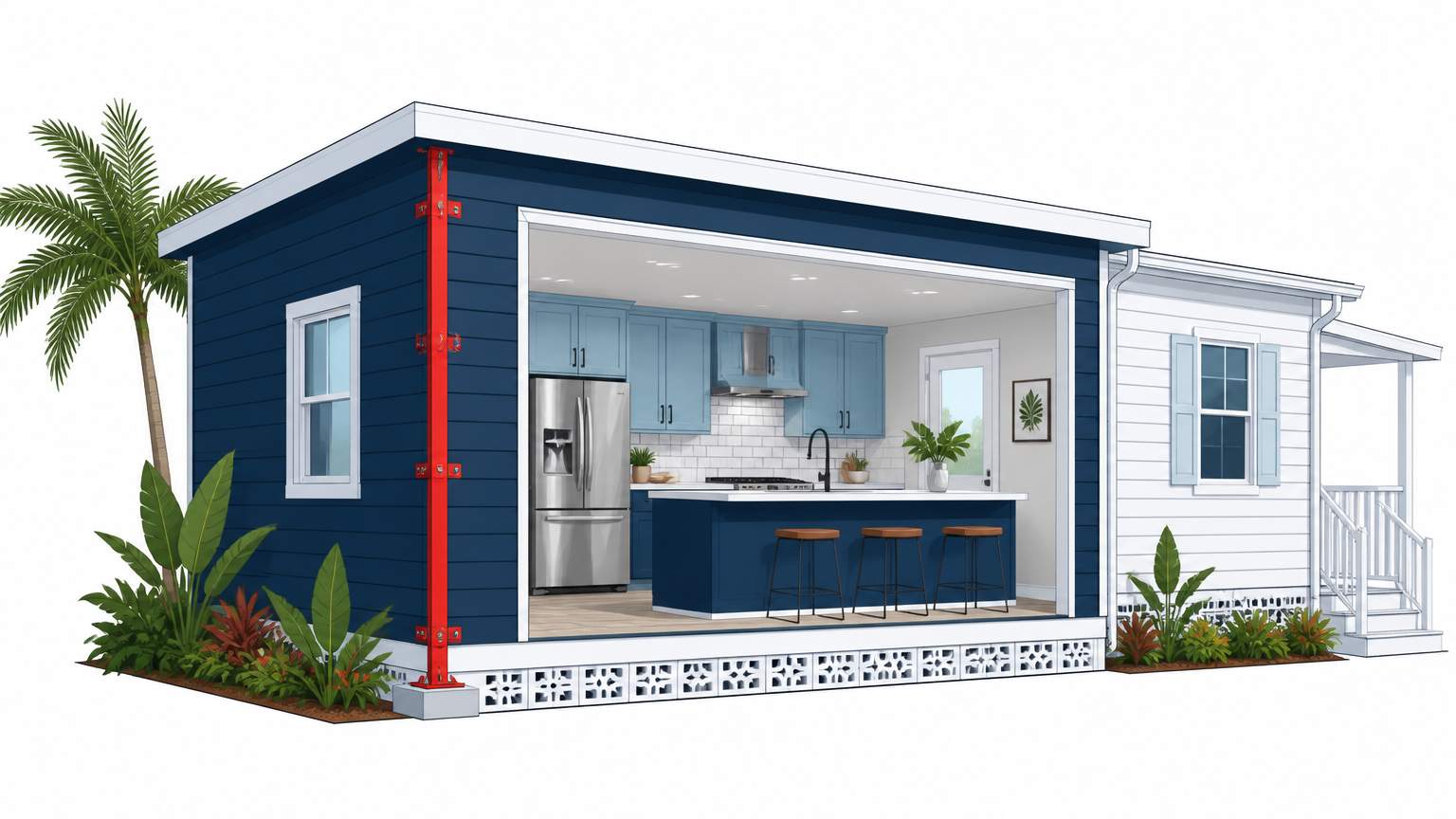
For those looking to add a kitchen or bathroom to a manufactured home in South Florida, vertical tie-downs are now required. This follows Wall-of-Wind testing at Florida International University, which revealed that structures built to Wind Zone 1 standards can fail at wind speeds much lower than expected. Without vertical ties, the structure is at risk of lifting and toppling in gusts of 60–65 mph, a wind common during the region's hurricane season. Installing vertical tie-downs during the design and build phase helps keep the project on budget and protects any high-quality finishes.
The Wall-of-Wind findings highlight a vulnerability in improvements added to manufactured homes. When a kitchen or bathroom is added, the extra weight and changed load paths put more strain on the foundation. If the only restraint is horizontal straps, the new load may create uplift forces that the structure cannot endure. Adding vertical tie-downs, which are anchored directly to the concrete pad or pier, provides a rigid, ductile connection that can withstand both uplift and lateral forces. Reports from NIST Technical Reports 5370 and 5664 confirm that well-sized and preloaded vertical ties can handle wind speeds up to 130 mph, far exceeding the 70 mph minimum for Zone 1. Practically, adding a single strap from pad to pad can be done for little additional cost. Many suppliers now offer thicker straps set in concrete plugs for quicker installation and better performance.
This added structural feature falls under the permit process which governs any addition. For instance, Palm Beach County requires permits for kitchens or bathrooms that change the footprint or add weight. The county code refers to the Florida Building Code, which uses the International Residential Code that has a Wind Zone 1 requirement of 70 mph. However, these recent tests indicate these minimums may not be suitable for some manufactured homes. By adding the vertical tie-downs, you meet the current code and prepare the home for the higher winds expected in the area.
The main risk is that if a failure occurs during a hurricane, it can ruin the new kitchen or bathroom and lead to injury. Wall-of-Wind data indicates structures without vertical ties can overturn at wind speeds as low as 60 mph, a wind speed that is not rare in the coastal region. Claims to insurance after such a failure may be denied if the home does not include the new tie-down standard. In addition, a toppling house can cause damage to interior finishes, plumbing, and electrical systems, extending the project time and costs for repairs.
Another risk is a possible permit denial if the design lacks the vertical tie-downs. The local code could become stricter post-testing. A contractor who skips adding them may face a re-inspection or a stop-work order, delaying the project for weeks or even months and adding costs. If the vertical tie-downs are poorly installed—using the wrong anchors or spacing them out too far—the system may not function. Proper design and correct materials are essential to ensure the structure can endure the expected wind loads.
American Developer Group, a design-build company working in Boca Raton, Delray Beach, and Fort Lauderdale, now includes vertical tie-downs in its kitchen and bathroom remodels by default. Their contractors are licensed and follow the latest code updates, using proven anchoring systems. This protects homeowners from wind damage while providing quality finishes.


